How to Write a Recommendation Letter (With a Real Example)
A recommendation letter earns its place by being specific. The reader already expects praise; what a CV cannot give them is how you know the person, one or two results only you would know, and whether you would put your own name behind them. If a sentence could describe almost anyone, cut it.
Disclosure: we build PaintPDF. The structure below is the one our recommendation-letter generator lays out, and the example is a real render of that layout.
What a recommendation letter has to do
Three jobs, in order:
- Establish your standing. Who you are, how you know the candidate, and for how long. A reader weighs a letter from someone who managed the person for three years differently from a note from a passing colleague.
- Give evidence, not adjectives. One or two specific results, with an outcome. "He rebuilt the order-sync service and cut failed syncs by 78%" beats "he is a hard worker".
- Make one clear recommendation. Say plainly that you recommend them, and offer a way to follow up.
The structure
A recommendation letter is short, one page, and has a predictable shape:
- The writer block: your name, title, organisation and contact details, opposite the date.
- The recipient, and a subject line naming the candidate.
- An opening that states the relationship and how long you have known them.
- A paragraph of evidence: a project or a result, with the number.
- A short paragraph on character: how they work with other people.
- A closing endorsement, and an invitation to contact you.
- A sign-off with your title and contact details.
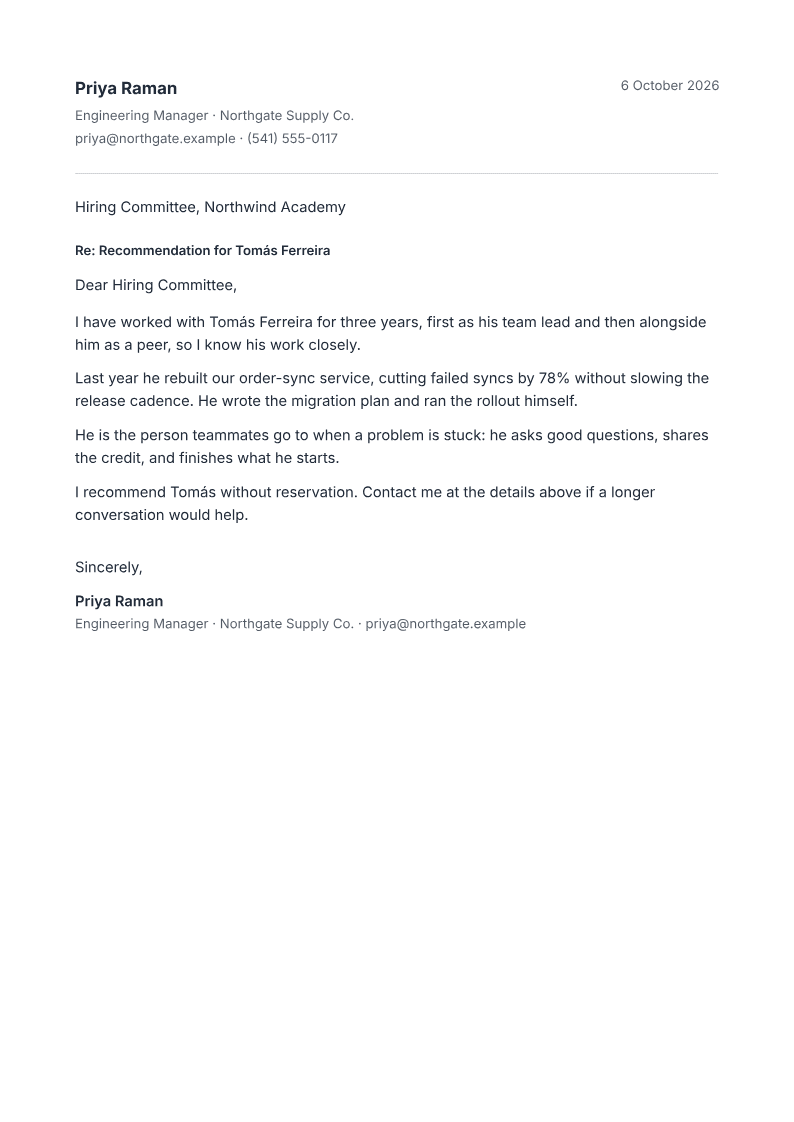
Draft one at the recommendation letter generator, or keep reading for the parts that go wrong.
What to leave out
- Praise with no fact behind it. "Excellent communication skills" tells the reader nothing they can weigh.
- Hedged endings. "I am sure they will do well in the right role" is not a recommendation. If you cannot recommend someone without a hedge, say what you can honestly support instead.
- Anything you cannot stand behind. You are signing it; the generator formats the letter, it does not verify the claims.
- A page of backstory. The reader is deciding, not reading a history.
Recommendation or reference letter?
They are different documents, and using the wrong one wastes a reader's attention:
- A recommendation letter argues for someone: how you know them, what they did, and why they should be chosen.
- A reference letter usually confirms facts: the role, the dates, the duties, and that they left in good standing.
If you are advocating, write a recommendation. If you are confirming employment, write a reference. The recommendation letter generator drafts the first; the reference letter generator drafts the second.
A worked example
Priya managed Tomás for three years. Her letter states that relationship, gives one result (the order-sync rebuild, 78% fewer failed syncs, run by him), one line on how he works with people, and an unambiguous close: "I recommend Tomás without reservation." The evidence paragraph is the part a reader remembers; the rest is scaffolding around it.
Frequently asked questions
How long should a recommendation letter be?
One page. Four short paragraphs, the relationship, the evidence, the character line and the endorsement, are enough. A longer letter usually means the evidence is thin and the praise is doing the work.
What should a recommendation letter include?
Your details and the date, the recipient, a subject line naming the candidate, how you know them and for how long, one or two specific results, a line on how they work with others, a clear endorsement and your contact details.
Can I write one for a student or a volunteer?
Yes. The structure is the same: state the relationship, give one or two specific examples, and close with a clear recommendation. For a student, the "results" might be a project, a placement or a competition.
What is the difference between a recommendation and a reference letter?
A recommendation advocates for someone's ability and character; a reference confirms facts such as the role, the dates and the duties. Use the recommendation when you are arguing for the person, and the reference when you are confirming their record.
Can I use a template?
Yes, as a starting point. The value is in the specifics only you can supply, so give the generator the relationship and the evidence, then check every name, date and figure before you sign it.
Turn the relationship and the evidence into a formatted A4 letter you can edit by chat. Free to start, no watermark.
Draft the letter